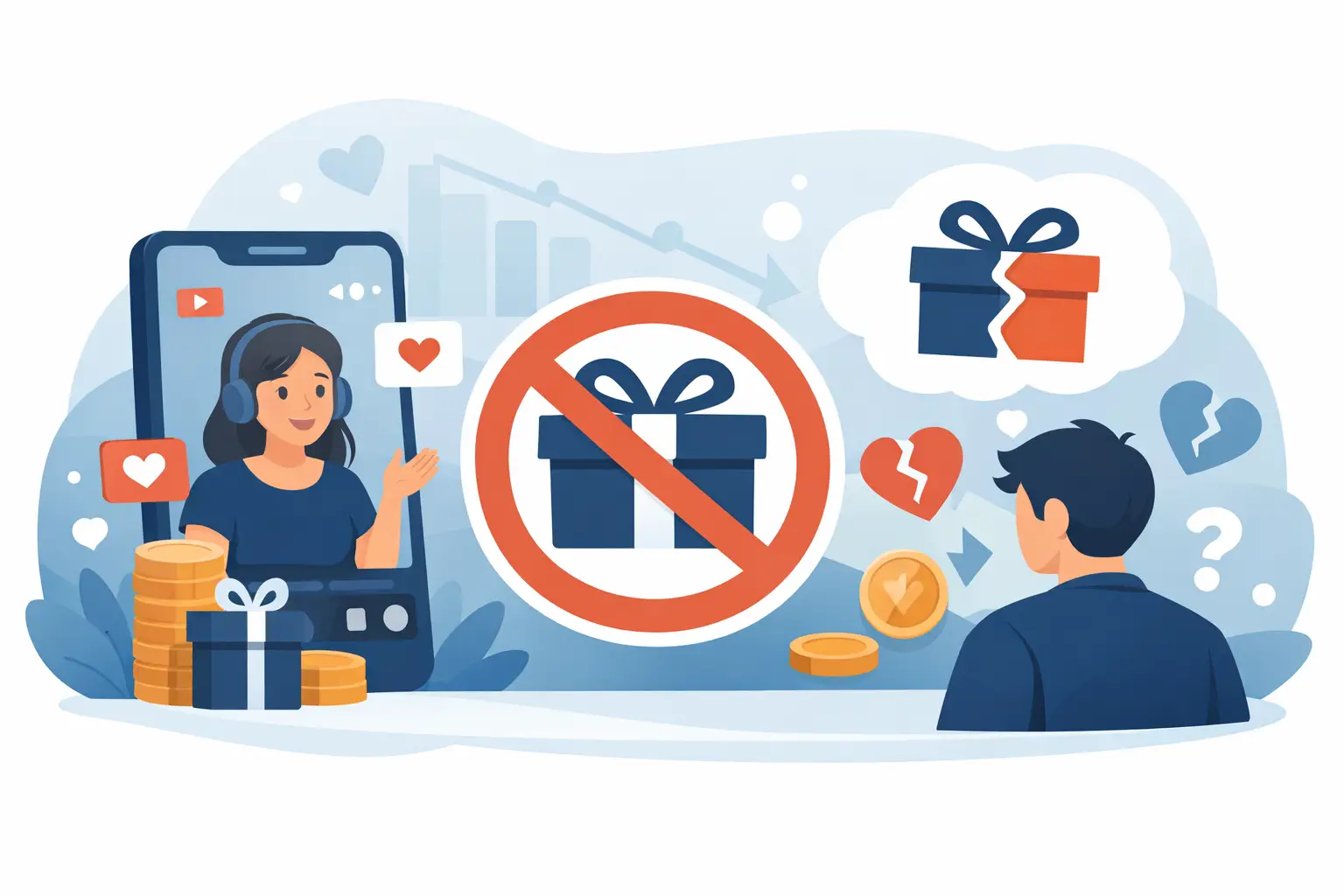
The drop usually happens fast. Chat is moving, a few gifts land, the room feels alive - then the energy flattens out and gifting stalls. If you are trying to figure out why viewers stop gifting, the answer is rarely that your audience suddenly got cheap. More often, the stream stopped giving them a reason to act right now.
Gifting is not just support. On live streams, it is behavior driven by timing, attention, status, and payoff. People gift when it feels visible, fun, competitive, and tied to something happening in the moment. They stop when the stream becomes passive, predictable, or crowded with dead air. If you want gifting momentum, you need more than a loyal audience. You need a live format that keeps pressure on the room.
Why viewers stop gifting when nothing changes
A static stream kills urgency. If every gift gets the same reaction, every round feels the same, and nothing on screen evolves, viewers quickly understand the pattern. Once they know there is no twist, no rivalry, and no consequence, gifting starts to feel optional.
That is the core issue for many creators. They assume viewers gift because they like the host. That helps, but it is not enough to sustain a full session. People gift more when their action creates movement. If a gift changes the score, saves a team, triggers chaos, or puts someone ahead, it feels like participation. If it only gets a quick thank you, the excitement fades.
There is a trade-off here. Some audiences love a relaxed, talk-heavy live. But even loyal communities need moments of escalation. A stream can be personal and still have structure. In fact, the best gifting streams usually blend both - real personality and clear viewer impact.
The stream feels repetitive
Repetition is one of the biggest reasons gifting drops over time. Viewers are fast learners. If they have seen the same reactions, the same prompts, and the same pacing across multiple lives, the novelty wears off.
This gets worse when creators rely on gifting callouts without adding a game loop. Saying "send gifts" over and over does not create excitement. It creates pressure without payoff. The audience starts to tune it out, especially if they do not see a fun reason to join in.
The fix is not making your stream louder. It is making it more responsive. A good live has turning points. Maybe teams fight for control. Maybe gifts trigger instant in-stream actions. Maybe the room can influence who wins, who survives, or what happens next. The point is simple - viewers need to feel that gifting changes the show.
Weak incentives make gifting feel pointless
People do not always need a prize, but they do need a result. If there is no visible impact, no social recognition, and no game-like consequence, gifting feels flat.
This is where many creators lose momentum. They think incentives have to mean expensive rewards or huge promises. Usually, they do not. What viewers really want is instant effect. They want their gift to mean something in front of everyone else.
That could be control, disruption, progress, or status. It depends on your format and audience. Competitive rooms often respond well to team battles, score pressure, and comeback moments. Entertainment-heavy rooms may respond better to chaos, surprise events, or funny visual outcomes. Different rooms have different triggers, but dead incentive is dead incentive in any category.
Why viewers stop gifting when the room has no momentum
Gifting is contagious. When people see action, they are more likely to join. When the room is flat, they hold back. This is why early momentum matters so much.
A lot of creators wait for gifts before activating the energy. That is backwards. You need to create movement before the room fully commits. Strong hosts build anticipation, frame the stakes, and make the first few moments feel alive. Once gifting starts, they amplify it. They do not let the room wonder whether anything is happening.
Momentum is also fragile. Long pauses, weak transitions, and unclear direction can break it fast. If viewers do not know what the current goal is, who is winning, or what a gift will do next, the live loses its rhythm. Confused viewers do not become active gifters.
The audience cannot see the payoff clearly
Visibility matters more than many creators realize. Even if your viewers understand your stream, they may not understand what their gift actually does in real time. If the payoff is hidden, delayed, or too subtle, the emotional return drops.
This is a design problem, not just a hosting problem. The best gifting moments are easy to read. A gift lands and something obvious happens. Scores shift. Objects move. A team gets stronger. Someone gets blocked. The room reacts instantly because cause and effect are clear.
When that connection is blurry, gifting loses its thrill. People hesitate because they are not sure whether the action matters. That hesitation spreads. Once it spreads, volume drops.
This is exactly why interactive formats outperform passive ones. Tools that turn gifts into visible live outcomes create a stronger loop between action and reaction. For creators who want more than random spikes, that loop is where consistency starts.
Your calls to action are either too soft or too desperate
There is a sweet spot. If you barely mention gifting, viewers may not feel invited to participate. If you push too hard, the room starts feeling transactional. Either way, gifting can slow down.
The strongest calls to action are tied to the moment. They are specific, timely, and connected to what the audience is watching. Instead of generic asking, the host frames a reason. Help this team catch up. Trigger the next round. Save the match. Cause chaos. Lock in the win.
That language works because it gives gifting a job. It does not feel like a donation request. It feels like a move in the game.
There is also a pacing issue. If every minute is a hard sell, viewers get numb. If gifting prompts only appear after energy dies, they land too late. Good creators weave them into the live naturally, then let the gameplay or format carry the pressure.
The stream lacks competition
Competition changes behavior. It creates sides, urgency, and emotional investment. Viewers who would never gift just to be nice may absolutely gift to help their team win or stop another team from taking over.
This is why rivalry works so well on live. It gives the audience a reason to care beyond supporting the host. They are not just watching content. They are entering a contest.
Not every stream needs full chaos, but most gifting-friendly streams need some form of tension. Team scoring, round-based goals, survival mechanics, rank pushing, and comeback windows all help because they create a live reason to act now instead of later.
When there is no pressure, gifting gets postponed. And postponed gifting often becomes no gifting.
Bored viewers do not announce they are bored
They just stop participating.
This is the dangerous part. Many creators think silence means the audience is still watching comfortably. Sometimes that is true. But on gift-driven lives, quiet often means interest is slipping. The room may still be there, but it is no longer emotionally active.
Boredom usually shows up before a full drop-off. Fewer reactions. Slower chat. Less competition. Fewer copycat gifts. That is the warning sign. If you wait until gifting completely dies, you are already behind.
The answer is to refresh the live before it feels stale. Shift the stakes. Introduce a new mechanic. Reset the challenge. Split the room into sides. Add visual feedback. Tighten the pacing. You do not always need a huge format change. Sometimes one strong interactive element is enough to wake the room back up.
The fix is not begging harder
If you want to change why viewers stop gifting, build a stream where gifts do something worth seeing. That is the real shift. Better energy helps, better hosting helps, and stronger community helps, but format is the multiplier.
Creators who consistently hold gifting activity usually do three things well. They make participation obvious, they make outcomes visible, and they make each round feel alive. That is why interactive live tools can hit so hard. A system like StreamLive gives creators a way to turn gifts into immediate gameplay, rivalry, and crowd pressure without turning the stream into a technical headache.
The best part is that this is not about forcing every live into the same style. Some rooms want chaos. Some want competition. Some want lighter audience control. What matters is giving viewers a clear reason to move from watching to acting.
When your audience feels that their gift changes the story, gifting stops being a favor. It becomes part of the fun. And that is when the room starts playing to win.